
It all began with a house fire.
On April 25th, 2018, a beautiful home on the water in Rosedale, Gig Harbor, caught fire. The fire raged so hot that the homeowners’ RV melted into a puddle in the garage, and firefighters called for the assistance of a fire barge to spray the water side of the house with cold saltwater from Puget Sound. In the process, the spray from the barge came through the living room wall and ran down the lid of a flame mahogany 1925 Steinway Model L piano, soaking the soundboard and causing it to crack from the shock.
Though the back curve of the piano had blistered from the heat, the piano survived the soot-water damage and was even playable in the rubble. It was out of tune and sticky, but Arukah restoration was possible.
My mentor, Loren Kelley, was giving me a tuning lesson when I first learned about it. “Hey, Jordan… are you interested in a restoration project?” It had been several months since the fire happened, and the charred roof had barely covered the piano in the meantime. “It’s a Steinway, but it’s in rough shape. It’s basically been in outdoor storage for months. But I think it’s probably worth restoring and would be a good project for you.”
A few weeks later, I accompanied Loren to the fire scene to appraise the piano. Donned in headlamps, we scrubbed soot off various spots to see the extent of the damage and how difficult it would be to fix. Loren deemed it worth repairing and said that it would be a good project to take on if I wanted to learn how to restore pianos, as nearly everything needed to be redone.
The owner agreed on a price, and I scheduled my technician/mover friend, David Nettleton, to move it on December 10th, 2018. When December 10th arrived, my Mom and I talked to the owner for a bit while David packed up the piano. I usually don’t talk about my story, but my Mom began sharing with the owner how I came to be a piano technician and what I wanted to do with the piano. I told him: “In many ways, I identify with this piano. Through fire and saltwater, trials and tears, something beautiful can rise from the ashes. I want to be part of that — to restore the piano’s song — and use it to record my first album.” He loved the story and message of what we wanted to do and decided to give us the piano for free. Thanks to him, I was able to complete the project much faster with the extra funds, although it still took four years to finish.
I have kept in touch with the owner and his family, and they have since moved into their new home, which was built on the same property.
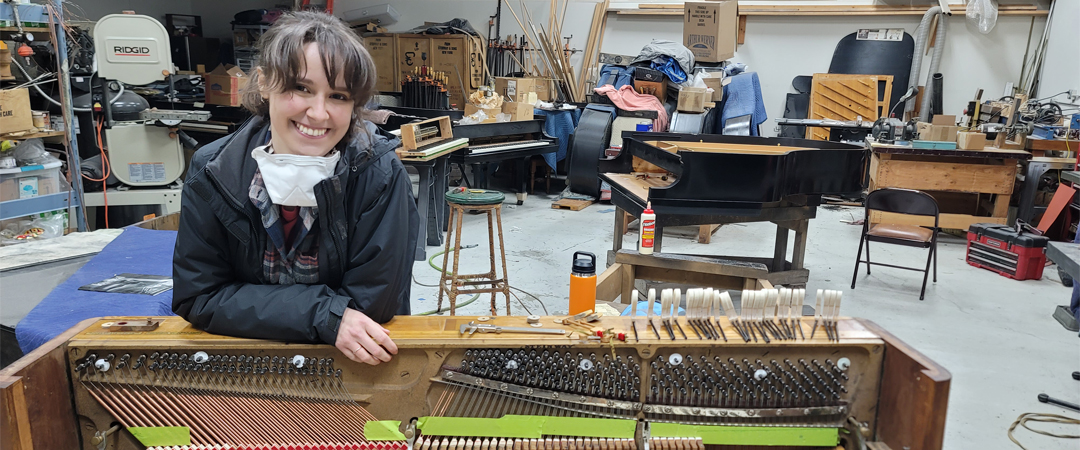
Jordan A. Cook is a piano rebuilder and visual artist whose work is rooted in the belief that beauty and meaning often emerge from what has been broken. She specializes in the restoration of pianos with extraordinary histories and is one of very few technicians actively restoring WWII-era Steinway Victory Verticals–compact pianos sent by B-17 bombers into active war zones to boost troop morale.
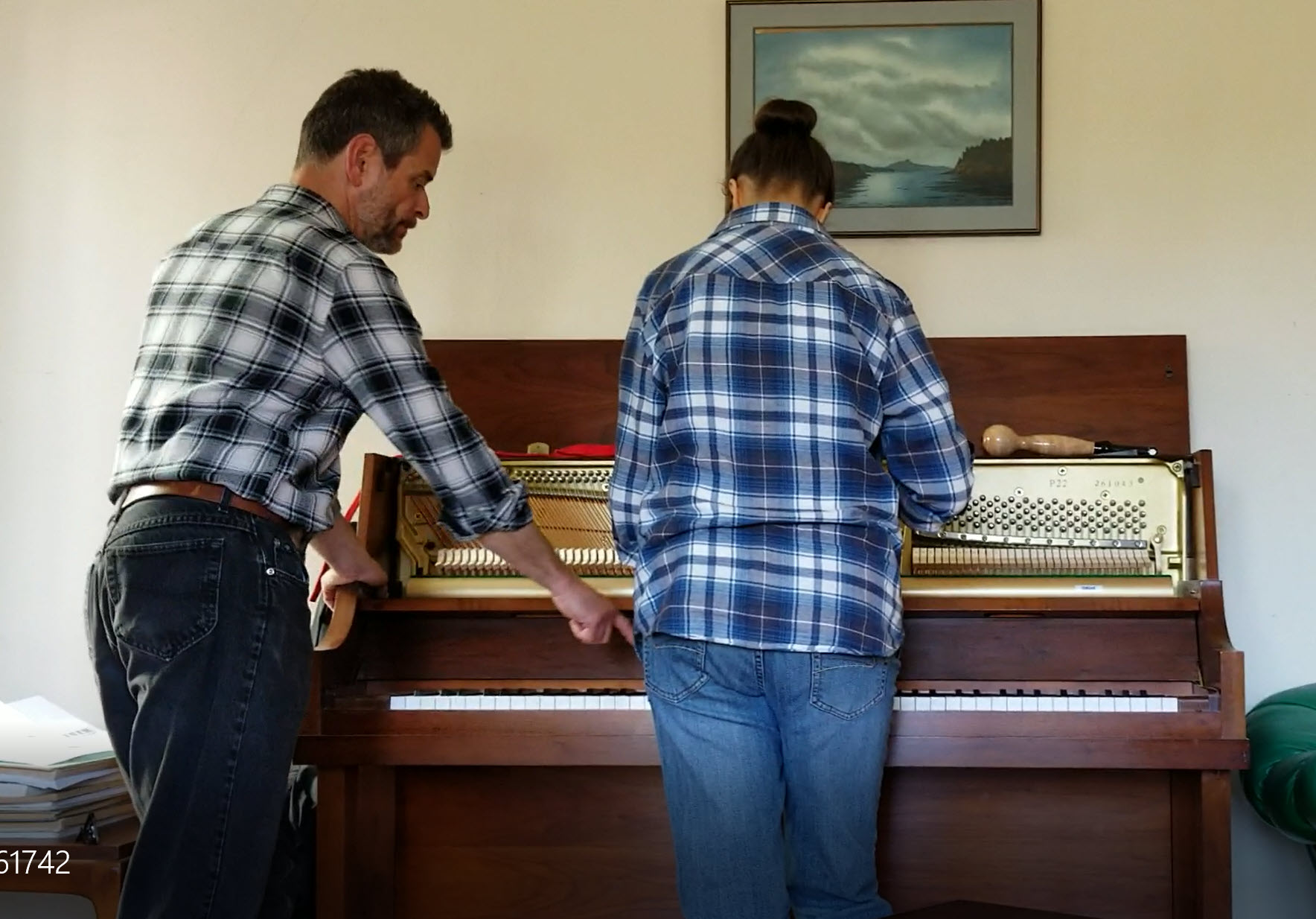
Jordan began apprenticing as a piano tuner with Loren Kelley in 2017 and as a piano technician with Phil Glenn in 2018. Since that time, Jordan has worked with and been mentored by Ed McMorrow of Lighthammer Piano. Jordan and Ed are now embarking on the restoration of a second Victory Vertical piano, Unknown Soldier.
In addition to restoration work, Jordan composes music and is an internationally exhibited artist working in gouache, watercolor, and mixed media, utilizing her own foraged pigments. Jordan has been painting since she was two years old. A prodigy in art, her work has been featured on television, radio, and in American Girl Magazine. Her paintings have been shown in historical and contemporary galleries around the world, including the Children’s Holocaust Museum at Terezin (Czech Republic), at the Matterhorn (Switzerland), in Israel, Morocco, Africa, China, at Maidan Nezalezhnosti (Independence Square, Kyiv, Ukraine), and across Europe. Locally, at age nine, she had a joint gallery showing with the late Fred Oldfield at the Western Heritage Museum Art Gallery in Puyallup, WA. At age 12, she participated in a concert of the late classical pianist Kim Clement at King David’s Tower (Israel).
Whether restoring a war-torn piano or painting with pigments made from earth and ash, Jordan engages in a quiet dialogue with time, creating works that bridge generations.
“Re-creation and restoration are my favorite ways to create. Something new rarely has the depth of something re-newed, and I am grateful that I get to work where history and technology meet. There, the greats of yesterday and tomorrow blend and integrate, bringing the future into the present.” – Jordan
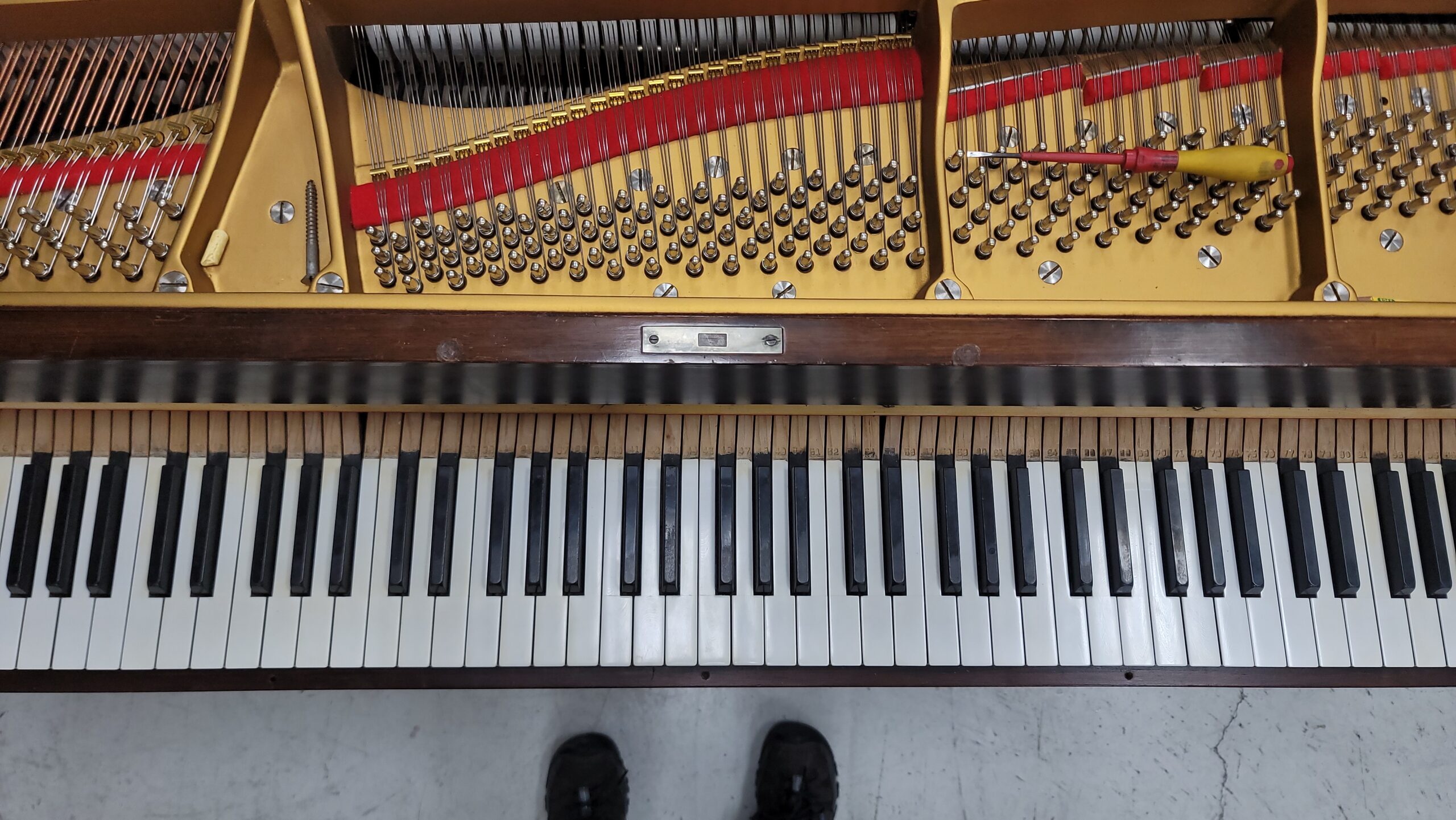
The mission of Arukah Piano is to restore the piano’s sound to its fullest capability while preserving its legacy.
What is Arukah?
Arukah (אֲרוּכָה) means restoration in Hebrew but conveys more than the English idea of making something like it once was. It means restoring something to better-than-original condition. The full definition is restoring to soundness; wholeness (literally or figuratively); health, or perfection.
What is the logo 𐤀?
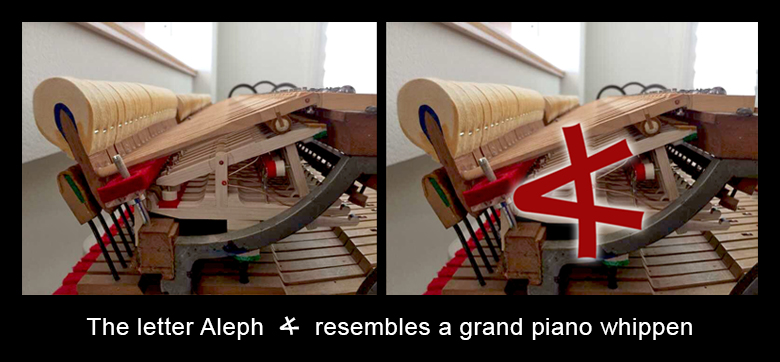
What appears to be a sideways “A” is actually an aleph, the first letter of the ancient Hebrew/Phoenician alphabet. It is a natural choice for a logo because it is the first letter in the word Arukah, and it resembles the shape of a grand piano action whippen. The whippen is the main part of the action, responsible for transmitting motion from the piano keys to the hammers, allowing them to strike the strings. They are one of the main factors in providing dynamic control. Like the whippen, the aleph is a silent letter that helps make sound when combined with other letters. As the first letter of the alphabet, it means beginning. Arukah Piano brings new beginnings to pianos by restoring sound.